Sunday, August 17, 2008


I have no clue how a bird made of concrete can fly.  But I have no doubt that it's flying.  Rows and rows of chairs are delicately arranged inside it's belly and every seat is full.  A Oaxacan Jazz band is playing modern jazz songs inspired by Mixtec traditional music.  I'm fascinated, the music emanates through the people, feeding them life.  They are the birds cells, they are particles of partially digested worms and bread crumbs.  Behind me the birds giant concrete stomach rotates, mixing wet cement and waiting for the jazz to push us back into it's swirling mass to be digested and converted into the spectacular energy that keeps this giant avian airborne.  The jazz jumps and sputters, tickling my brain.  Maybe I am a mitochondria.  A long table of meticulously arranged wineglasses awaits as people dressed in T shirt tuxedos pour bottle after bottle of pinot nois to entertain the guests/masses of food until they hit the stomach acid.    I sip delicately, not worried about being digested, it's all part of the cycle of life.  With each powerful flap of it's concrete wings we move forward in time, soon we arrive at yesterday, even though it's two and a half weeks forward on the timeline of this story.  The bird has a craving for the flavor of melancholy, and so thus it begins my retelling at an emotional low point, which is, not so surprisingly, an introspectional high.  
I was sadder than I've been since I've been down here, for no good reason, just on that side of the pendulum's oscillation.  It's amazing how moods change your perceptions of things.  The brightly painted building stood out almost offensively against the stormy sky and the constant motion of the passersby seemed obsessive.  I sat in various parks and smoked a few single cigarettes, which you can buy from indigenous women and children who walk around with little portable convenience stores strapped around their necks.   
In these types of moods, I become enthralled by small details.  Little things that pop out of the landscape and call to me.  I feel like they're also lonely and that I'm the only one who's paid attention to them, despite their hidden value.  One of these things was a wounded monarch that limped around my patio.  I photographed it and then it got killed by the cat.  
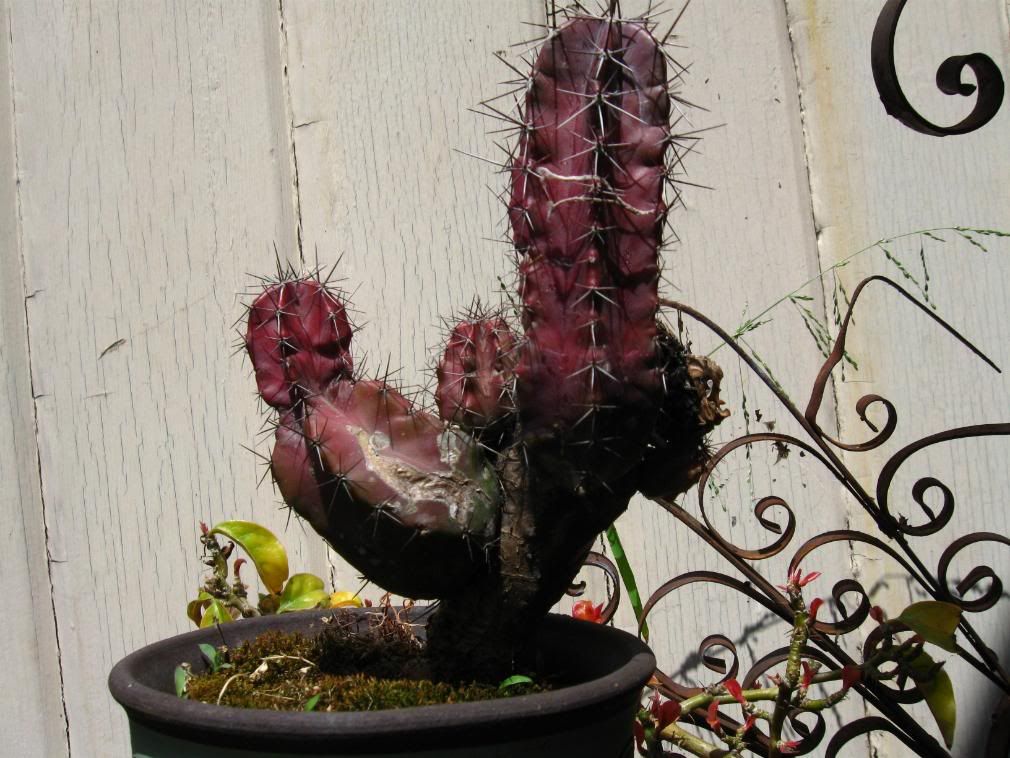
Another was a small section in an auto parts store that sells bonsai cactuses.  I walked by the place and stopped to take a picture of the huge sign that said "Autos America" on a sign in the shape of Mexico with a US flag painted across the country.  I realized a tiny little black sign with white letters beneath the huge monstrosity of advertising.  It said: "Bonsai cactus."  I walked in and it was just like a dirtier version of Les Shwab.  Hubcaps and engine parts and the types of guys who spend their whole lives working on cars and thinking about cars.  It's a huge store.  People filled it with chatter about cars.  It took me a while to find the Bonsai section.  It was through a little doorway with a curtain.  Another little sign hung over this entrance, which was even more subtle and unobtrusive than the first.  I waked through the curtain and almost ran into a little man who was taking care of his cactuses.  There were about ten of them, in a room smaller than my walk in closet at my apartment.  They were all rare cactuses, kinds I've never seen before.  I had been taking pictures everywhere I went, but I felt it'd be inappropriate in this little oasis, so I just looked and appreciated them in the moment.  The little man was old and retired, he'd worked as a bus driver for years and had been part of the workers union.  He retired and bought this closet from Autos America and now he stayed there all day taking care of his prickly friends.  I asked him if he got a lot of business and he said no, people usually just wander in here while waiting for their cars to be repaired.  They cast a disinterested eye around the small room and go back to "America" to argue over the price of their tune up.  I asked him about each cactus and he told me where it originated, it's name in latin, how he cared for it.  I told him about how for probably about 5 years now, I'd been buying my dad bonsai cactuses to keep in his office at work.  The same bizarre gift every year.  He's got a little collection, and its always meant a lot to me that he keeps them alive.  You only have to water them like once a week or so, but nonetheless, many people let them die.  His little collection has moved though three different offices in the five years.  If I could somehow send him one, I'd buy one right now, I said, but since I'm not going back for 40 days, and I don't want to carry a cactus through Central America, I don't think it'd make sense.   He said not to worry, unlike most Mexican vendors, he didn't pressure me to buy at all.  He said he didn't open this shop to make money, which was obviously true.  He didn't seemed bothered by the noise from the store next door.  He'd created a little corner of Zen.  I must've been in there for 20 minutes to a half an hour, looking at the little plants and chatting with that little man.  I left feeling the same, and went looking for another place that seemed out of place and matched my out of place mood. 

Saturday, August 2, 2008

Unexpected Party

The decapitated cadaver shot fireworks out of the orifice in his neck.  

We hook El Poderoso up to Manuel the housekeeper's car with jumper cables.  He sat in his blue Honda and revved the engine while Memo held the cables to the screws on Camelo's wobbly battery.  As the sparks flew, this profound little story (above fireworks) flashed into my head.  El Poderoso sputtered and quit.  Memo disconnected the circuit and connected it again.  Sparks. Another piece of the future flashed into my mind: "Cornelius Dark is totally immersed into those fantastic voyages," and his pencil sketched body decomposes.  With this bit of electrically stimulated prophecy, El Camelo woke from dormancy.  Memo pulled the e-brake, put it in neutral and stepped out of the car, smiling and gesturing to the puttering piece of junk like a valet returning a checked Mercedes to it's owner at the Hilton.  Angelina returned his sarcastic smile lovingly.  I got in the passenger seat and we began our day of errands, triumphantly rolling down the tunnel towards the streets of Querétaro.  But, when Mamá stopped the car so that I could hop out and open the huge wooden doors that give passage to the street, I was distracted by more time travel.  This was the last destination El Poderoso would take me to.  Soon I'd be in Oaxaca and I'd have to find another vessel if I wanted to return metaphysically to mi querido Querétaro and my family here.  The last stop on the relative future of the driveway timeline (instead of toot tooting like a train to tell my memories that it's their stop, El Camelo putt putts): It's two memories, trapped in the same part of my memory, opaque and overlaid like underdeveloped photos with dual images.  

I'm in the kitchen with Mamá and Alejandro Jodorowsky and I'm in the living room with Diego and Cornelius Dark.  Alejandro draws a corpse with blood from his own veins and our laughter shoots fireworks from it's open wound of a neck.  As the laughter dies down, Alejandro brings up a more serious point.  This contemplation is blended with the look of disdain on Diego's face as he lays on the couch for three days eating ice cream to sooth the pain left in the place of his molar.  
"I know a trick to get your mind of that pain," I tell him.  I punch him in the shoulder and fill my right cheek with air to mock his puffed up face.  Rebe runs by me and I pick the little kitten up and throw him at Diego.  He chuckles a bit.  Cornelius Dark looms up through Diego's jaw and grimaces in a painful laugh.  He is Diego's dead body.  He is in the room with us.  I think about what else I can do to cheer Diego up.  Cornelius Dark scoffs at me.  Alejandro Jodorowsky says that God was replaced by his own creation: the first cause after creating nothing but effects for eternities.  I ask my mamá what that means.  Her eyes open so wide I wonder if they're going to pop out and expose her brain.  She starts to talk in a tone that puts me in a trance.  The words she says are instantly encoded in my amygdala and bypass the hippocampus altogether.   I'm unable to write them on my mental sketch pad.  I'm left with just an odd, (imaginary?) image.  Both haunting and mysterious.  She reaches across the table and flips open the top of my head exposing a ball of white wax with a new white wick sticking out of the top.  She lays a flat palm on the smooth shiny surface.  When she moves her skinny fingers past the wick, it ignites, like a gas burner.  I sit there with my head burning for an indeterminable amount of time.  Cornelius Dark's opaque image rises out of Diego as he falls asleep on the couch and the TV babbles on about Hollywood's richest wives.  He's wearing an enormous backpack and an open wound in his chest exposes his heart.  He's rapidly decomposing.  I'll meet him again, I know it.  I think of my own dead body and wish I could meet it like Felipe Delgado.  Even if I never see him face to face, I love this old man and I'll follow him forever.  

The Querétaro streets move past the window slowly and efficiently as El Camelo pulls us across the city.  He's been a good car, a good metaphorical time machine.  Mamá looks at me and asks where my mind is.  She rubs my fuzzy hair that will soon be an burning flame.  
"In Oaxaca."  I say.  And a giant concrete bird full of jazz swoops down from the sky, devours El Camelo, and begins it's migration south.


Mamá shook her head


and shrugged her shoulders.  
"A veces El Camelo no quiere salir.  Teine sueño, tendremos que despertarlo."  Her tone was that of a statement and a question at the same time.  She looked at me with her expression of permanent curiosity, her thin face raising with her eyebrows.  Jaime Saenz says to come to love a person, you have to imagine their body without flesh.  You have to see them as skeletons.  This concept has floated around in my mind since June and I sometimes make an effort while walking down a street which starts Eugene, becomes Guadalajara and then Queretaro and now stretches on toward Oaxaca, to envision the skeletons; to see the presence of death in peoples daily ambulations.  Mama's face is so thin, you don't have to guess what her skull would look like.  She has a beautiful skull, and because of this, her wisdom seems even more appropriate.  
We push El Camelo back to Saturday morning, feeling the lactic acid build up in our muscles and the shallow pool of tequila our brains are still floating around in.  It's a sore and groggy jog.  When we stop time traveling, I'm waking up on the couch.  My cousin Jorge, Diego and I are all passed out on the couches.  For some reason, Diego prefers sleeping on a couch the length of his torso with his legs hanging over the armrest to sleeping in his Diego-sized bed, which was left empty last night as Jorge supported his feet on the small living room table and sat with his head rocking from side to side in a cushioned  chair.  I laughed at this first scene.  It was 8:30.  I heard my mamá and Jordan (the student from a Baptist school in Texas occupying my past position as resident Gringo in the Montes/Espinoza household) making a very noble effort to communicate.  However it wasn't my urge to practice translation or a desire to contribute to intercultural understanding that made my whiskey stiff legs bend at the knee and pulled me off the sofa like a corpse under a spell... it was the smell of coffee.  I remembered how fortunate I felt last fall when I saw that my house had a genuine coffee maker and that Nescafe was not to be found in the cupboard.  I walked into the kitchen and Buenos Diased my mamá and offered Jordan a high five before pouring a cup of black gold.  I sat down with the two of them at the small kitchen table covered in a plastic sheet that has always made the kitchen smell laminated.  I can tell Jordan wants to get something across to mamá, and I struggle with my fellow  Gringo for a while as he gesticulates confusedly, reaching out into the air and trying to pick nonexistent vocabulary from invisible trees of words.  Immense pauses punctuated by tormented facial expressions serve as Jordan's comma's in his second language narration: "Mi novia..." he says, "tengo?" he asks, "un noche que es mal," he finishes and raises his eyebrow at me.  I nod encouragingly.  "Mmhmm."  He stars again.  "Ella..." the pause lasts even longer than usual.  I shrug at him as if to say "just tell me."  Relieved, he recounts the whole story to me.  After hearing it, I relay it to my mamá.  Only when I get to the end of my own narration does the gravity of the story hit me.  
Jordan's girlfriend, who's on the same abroad program and staying with another family, woke up at 5 Am to see the señor of her casa standing over her bed and staring at her.  El Camelo sputters unexpectedly and my memory is clarified as the engine turns over once, maybe considering waking up.  Kelly, Jordan's girlfriend, is now standing in the kitchen alongside her man, a stunned look on her face.  Actually, as I now remember, she had called Jordan as soon as the incident occurred and he'd loyally trotted over to her house and brought her back to safety here at our place.  She shook her head and said (in Ok Spanish and a unique raspy high pitched voice) "Me da miedo Señora."  El Poderoso sputtered again and she disappeared.  Rusty old Nissan was jumbling up my memories...that didn't happen till Monday.  The scene doesn't change much however, except for Kelly's absence, Jordan, Mamá and I all sat in the same seats, I still had a cup of coffee in my hand.  The food on our plates morphed from huevos rancheros to huevos a la mexicana and the kitchen still smelled laminated.  I'm describing a dream I had to my Mamá.  She's interpreting it.  She says that recurring snake bites probably mean that I'm soon to awaken in another plane, o sea, if I was to become conscious in my dream state, after the bite, I'd raise to a higher form of consciousness.  Mamá tells me all about the power of lucid dreaming and about different ways to interpret dreams.  I don't know if any of it is valid but, something about her presence and her tone of voice and the reality of her inspirational life story make everything she says true to me.  forgetting the barrier for a second, she turns to Jordan and asks if he knows any Biblical interpretations of dream images.  Admirably persevering through the point where most Gringo's I know give in to "culture shock" and stop trying, Jordan responds slowly in Spanish.  However he starts fragmentedly  retelling a dream he once had so I interrupt and repeat her question in English.  I'm probably interfering with his learning process, but I want to have a good conversation.  He switches to his more comfortable tongue as soon as the last syllable is out of my mouth and explains Joseph and his coat of dreams.  His talk of pharaohs and such reminds me of the "Cartoon History of the Universe" and I bring up some of the contradictions and omissions in the Old Testament noted by Larry Gonick.  I ask him how literally he takes his faith.  What percentage of the Bible does he think is actually true and should be taken completely seriously. 
"100%!," he answers solemnly.  
"It's the word of God."  To avoid exposing my lack of knowledge of the actual stories of the book itself, I go straight to my most important point. 
 "Don't you think it's a contradiction to believe that one must love their neighbor and simultaneously believe that if their neighbor doesn't believe in Jesus Christ he's condemned to eternal damnation?  Isn't that kind of conceited, and, well...not so loving?"  Unlike most people I've asked this question to, he actually considers it for a while.  
"Well, Jesus says that the only way to heaven is through him.  I guess God just chooses who receives Jesus and who doesn't."  
"So, if someone happens to live up in the hills of some really remote region and they never have even heard of Jesus or had the option to believe, they're going to hell?"  He thinks again. (Which makes me feel that overall I've accomplished what I set out to do with my questions)  
"I guess thats just Gods will," he says in a sad tone.  
"Well, just consider it," I say, "and maybe you'll eventually come around and let them into heaven."  
"It's not my choice," he says.  
"I think it is," I tell him.
Jordan pauses for a long time, like I'd asked him something in Spanish..."Well, that's very interesting," he says finally.  
I've got a lot of respect for people with faith, I decided, after learning quite a bit from my chat with Jordan, if, that is, they're willing to investigate it.
Later on, while we puttered around in El Camelo, I'd tell my Mamá about this conversation we'd had.  
"I know you're not religious," she'd say "but how would you describe your religion."  I look at her, a "Catohlic" who sings her charkas every morning, takes classes on gnostic teachings and symbology, believes in the Tarot, reads about the holy place of corn in Mexican indigenous cultures and incorporates these stories into the way she flips the tortillas and how she defines herself as Mexican, has more faith in her favorite authors than any icon and spreads her good will and love through the world by helping people grow productive crops...I think about it and answer:
"This moment right now, this old car and you and me talking about religion and scurrying around Queretaro... this is my religon."
She laughs..."And if we were sewer cleaners, and we spent all day digging around in shit, would that be your religion?" she asks me.
"I guess so."